Filter conditions
Filter matching traces by attribute, node, transition, or throughput time.
Active filters
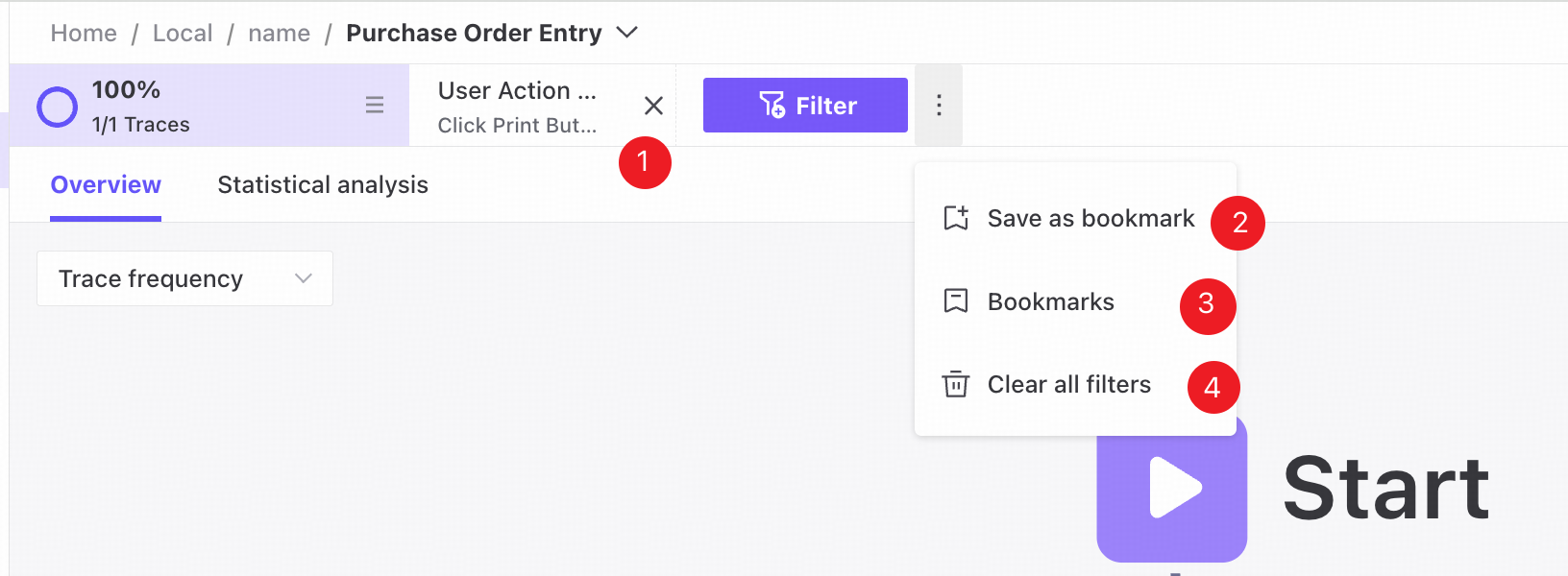
❶ Selected filters appear here. Click to edit a filter quickly, or click Delete to remove it.
❷ Save the current filters as a bookmark.
❸ Bookmark list.
❹ Clear all filter conditions.
Filter conditions
Filters help you focus on relevant task data for more precise analysis and decisions. Click Filter conditions at the top of the screen to open the panel and create filters.
Attribute filtering
Select the Attribute tab in the Filter conditions panel to filter by individual values in data model tables.
Filter types
Attribute filters support three data types:
- Numeric
- String
- Date
Numeric
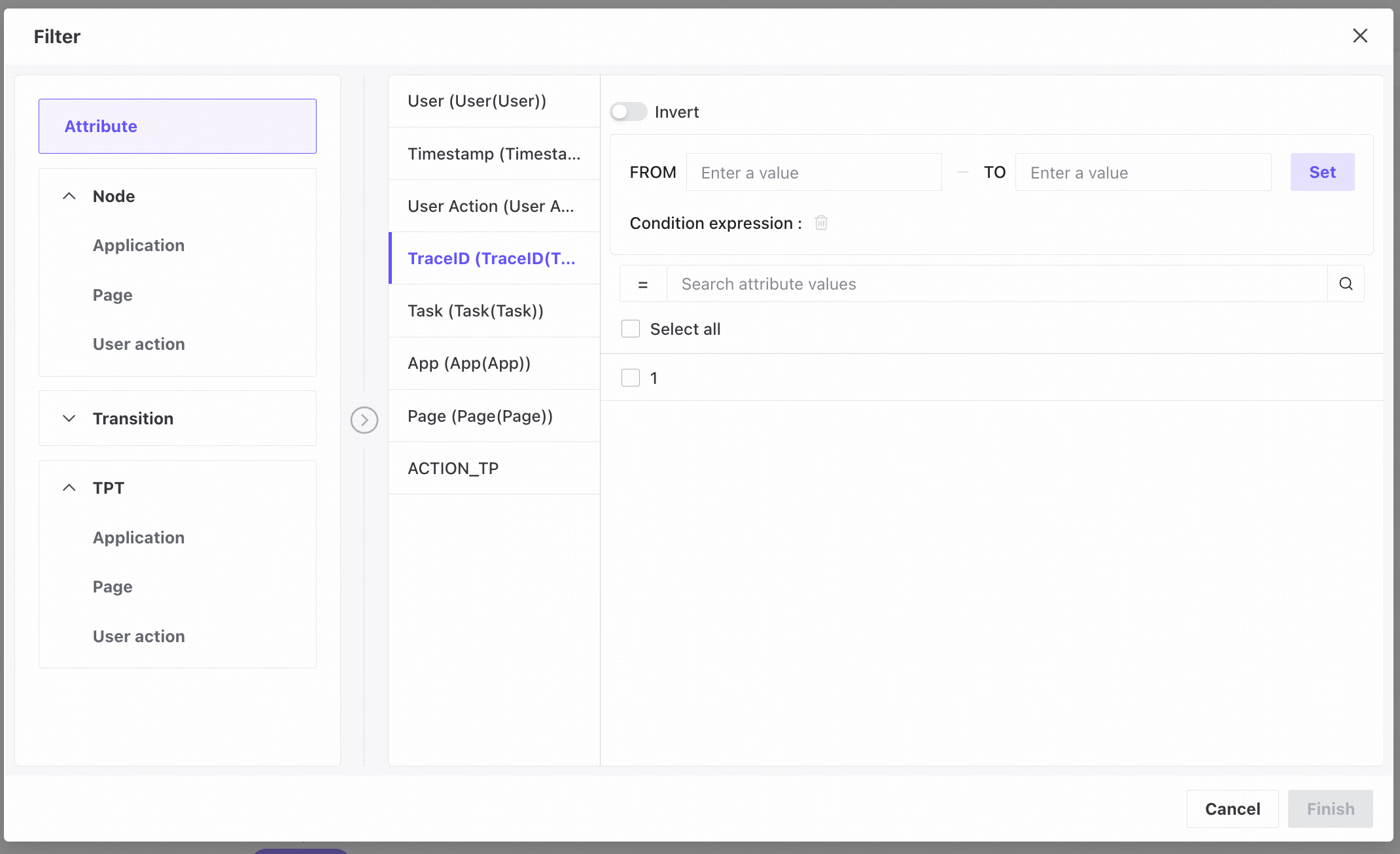
❶ Select one or more entries in the checkbox list.
❷ The numeric comparison selector defaults to =. Use it with the adjacent input to specify the numeric range to search.
The comparison selector is available only for numeric attributes.
❸ Enter a number and press Enter to display values matching the specified numeric range.
❹ Enable Invert selection to filter by all unselected values.
String
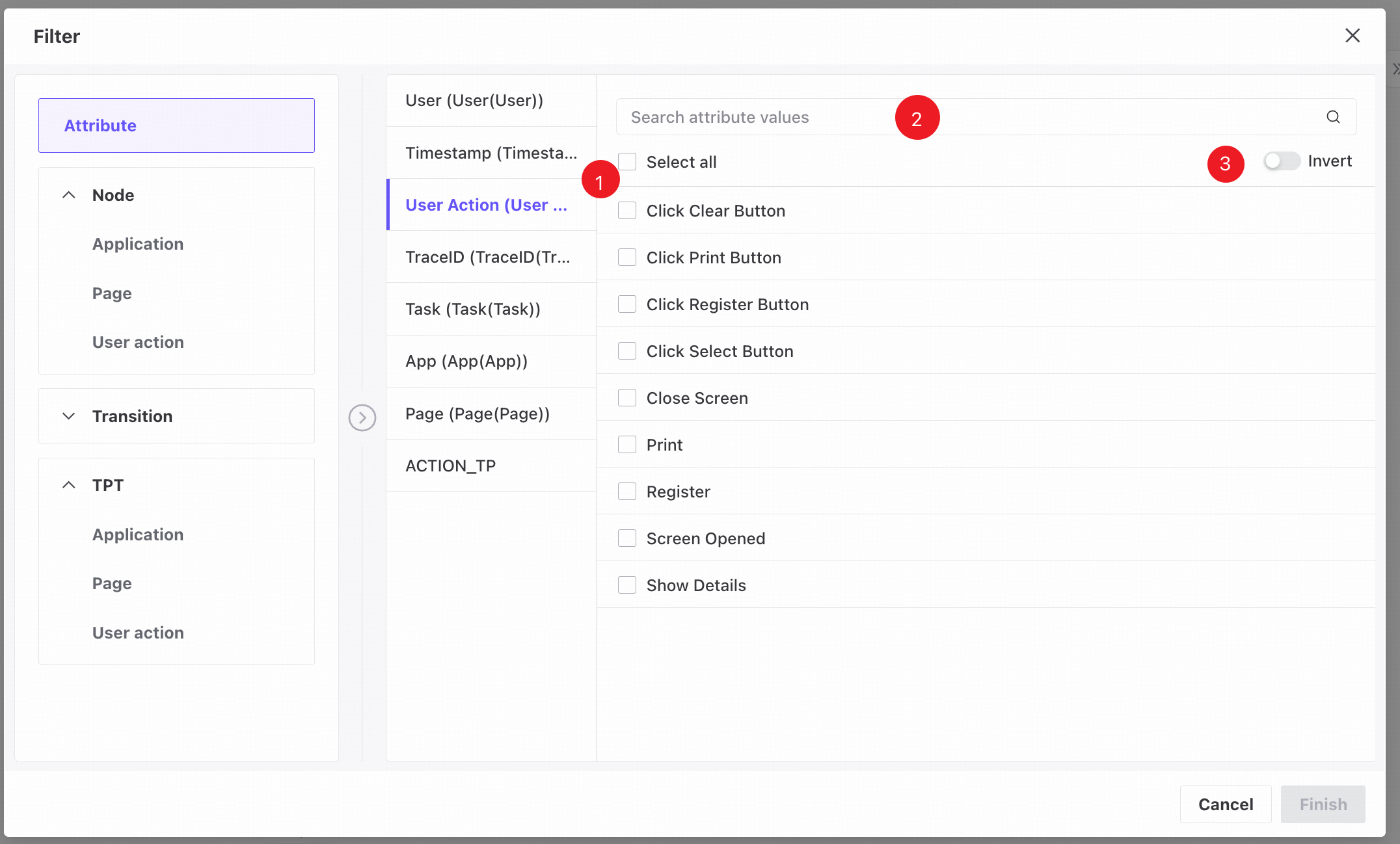
❶ Select one or more entries in the checkbox list.
❷ Enter a column value in the search box and press Enter to display values containing the search text.
❸ Enable Invert selection to use all unselected values as the filter.
Date
Date filters support range selection and attribute selection. Range selection is selected by default.
Range selection: select a date range.
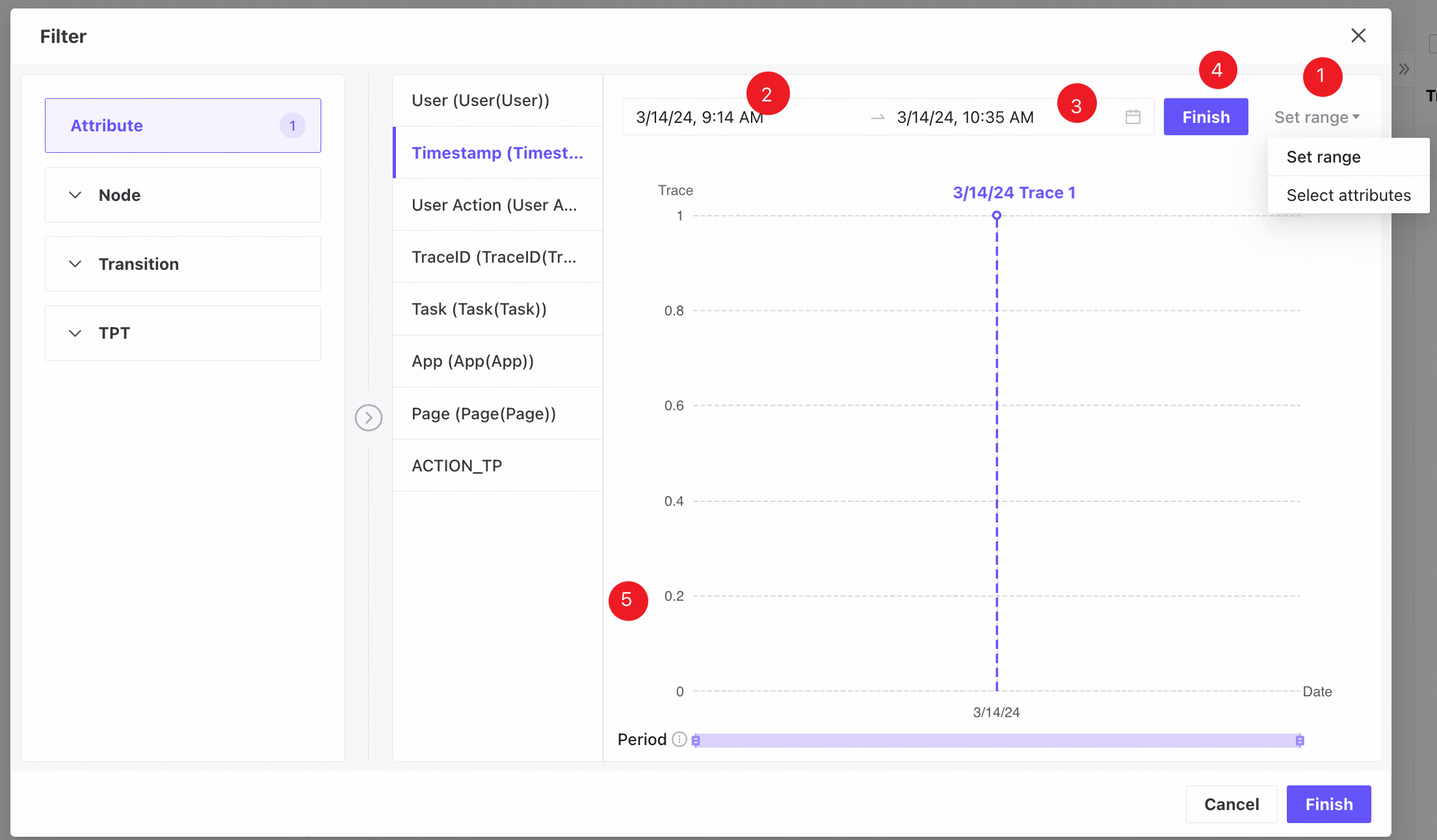
❶ Switch to range selection.
❷ Select the start date.
❸ Select the end date.
❹ After selecting a valid date range, click Finish to view the chart.
- Finish is disabled until both the start and end dates are selected.
- Choose a valid date range. The start date must not be later than the end date. Otherwise, an error appears and Finish remains disabled.
❺ The distribution chart. Drag the slider to set the time range and view detailed data.
Attribute selection: select individual dates.
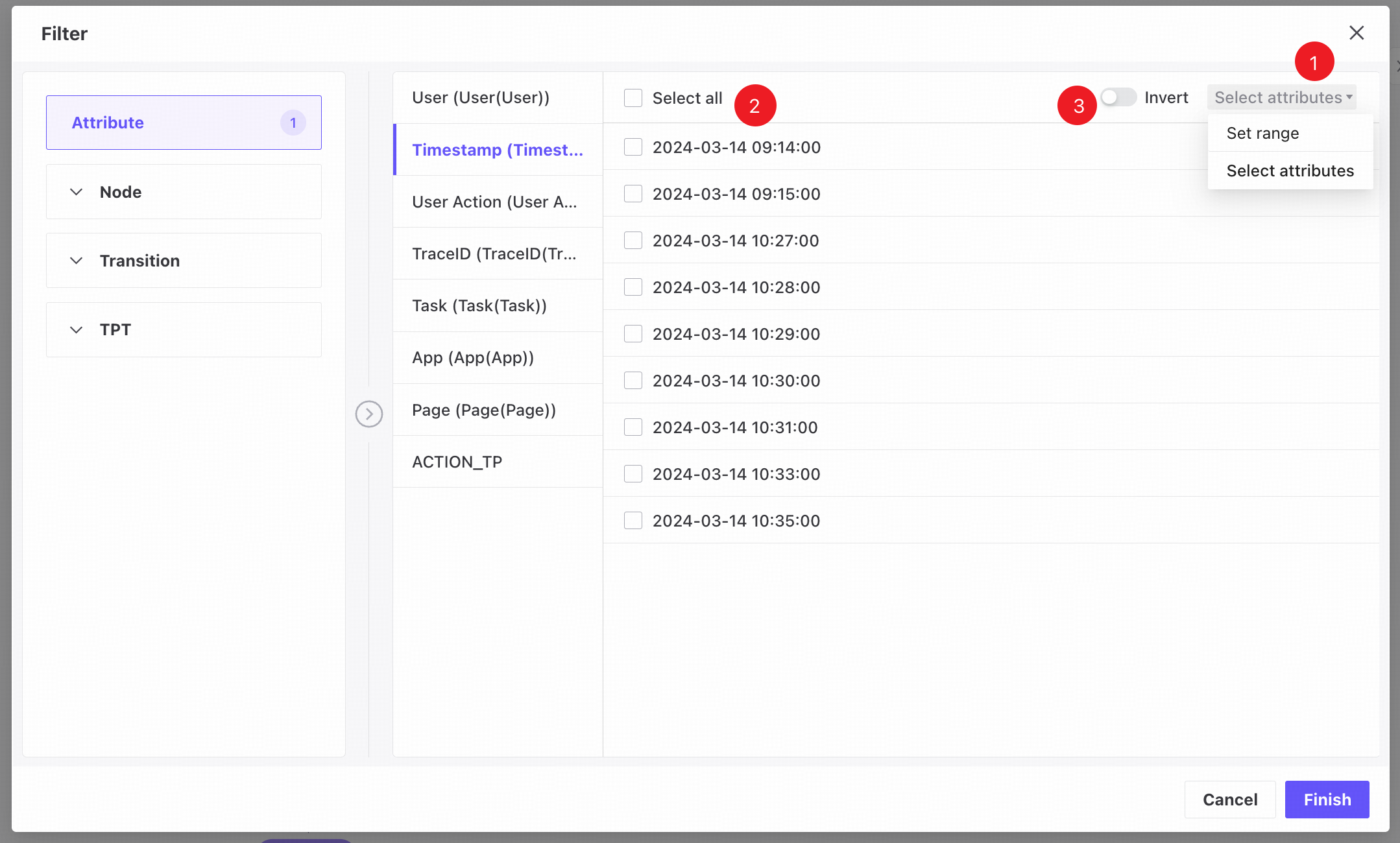
❶ Switch to attribute selection.
❷ Select one or more entries in the checkbox list.
❸ Enable Invert selection to use all unselected values as the filter.
Node filtering
Filter by the nodes a trace passes through. Nodes can be applications, pages, or user actions.
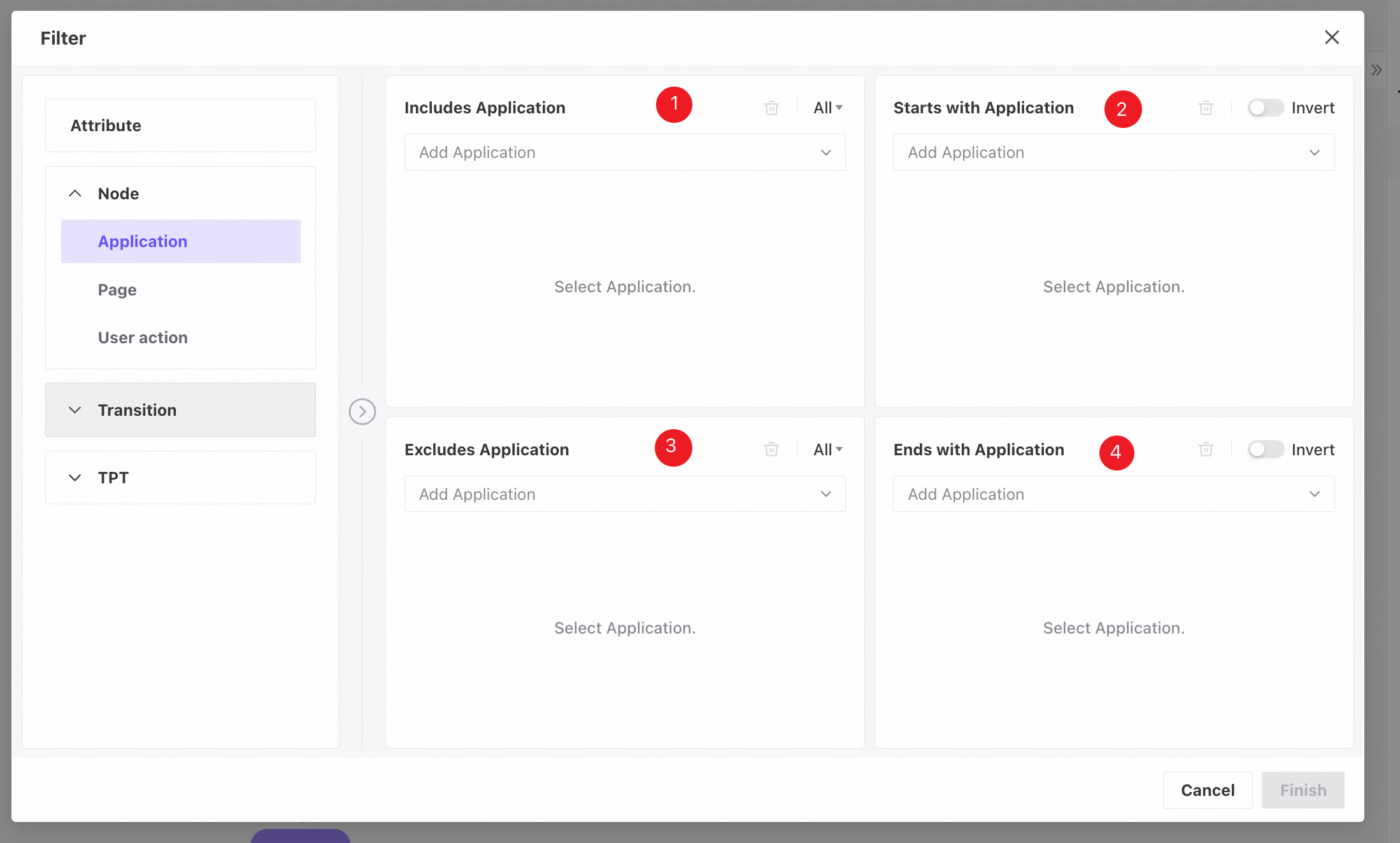
❶ Select one or more nodes to include traces passing through them. Use the upper-right control to choose all or any selected nodes.
❷ Select one or more nodes to exclude traces passing through them. Use the upper-right control to choose all or any selected nodes.
❸ Select a node to find traces starting with it.
❹ Select a node to find traces ending with it.
Node transition filtering
Select the Transition tab to filter traces by relationships between nodes. Nodes can be applications, pages, or user actions.
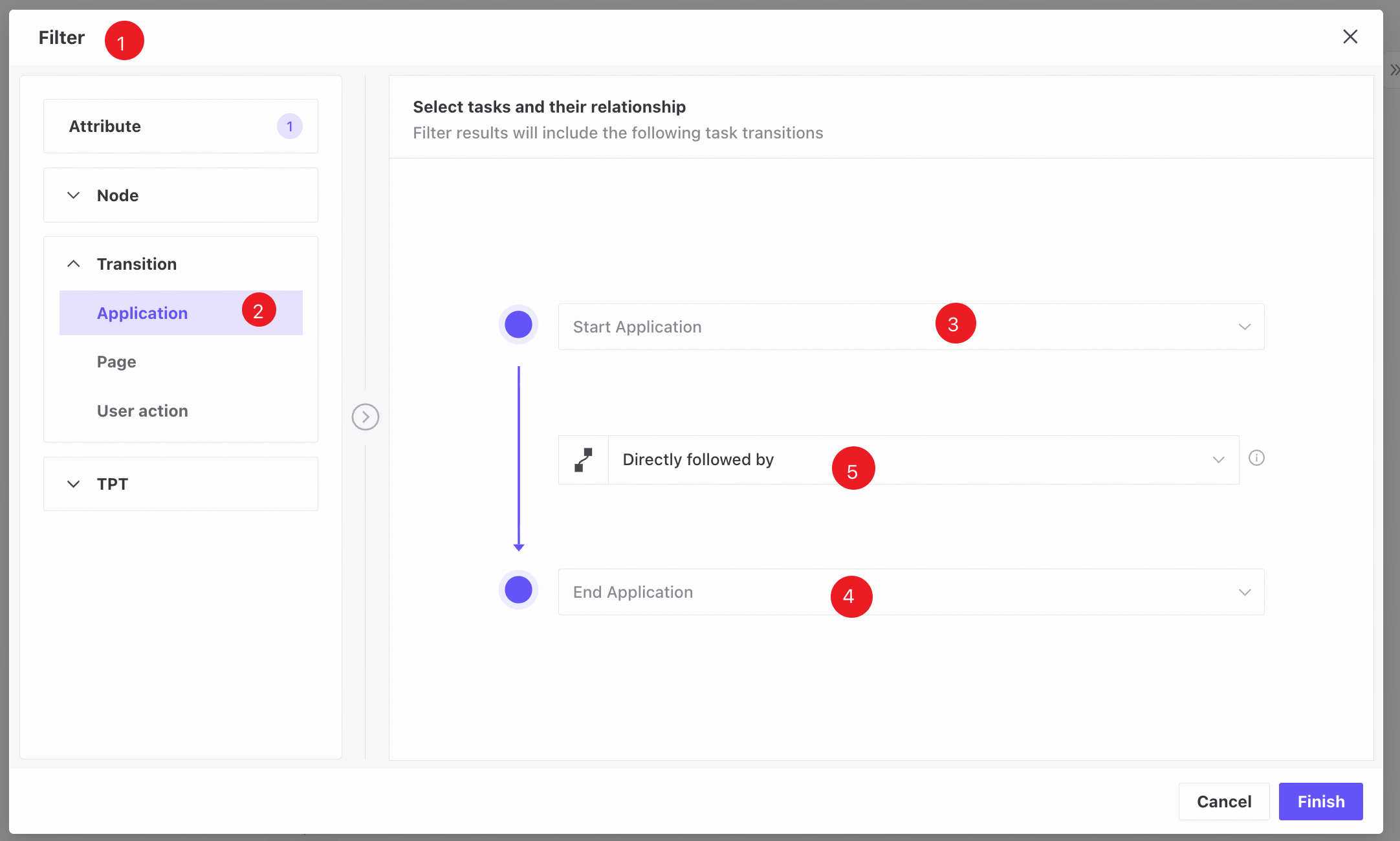
❶ Filter conditions panel.
❷ Transition tab: select the node type.
❸ Select a start node from the upper dropdown.
❹ Select an end node from the lower dropdown.
❺ Use the middle dropdown to select the relationship: Directly followed by, Eventually followed by, Indirectly followed by, Not directly followed by, or Never followed by.
Throughput time filtering
Select the Throughput time tab. Here, throughput time is the time taken to transition from Node A to Node B. Since a node can occur multiple times in a trace, choose its first or last occurrence. Nodes can be applications, pages, or user actions.
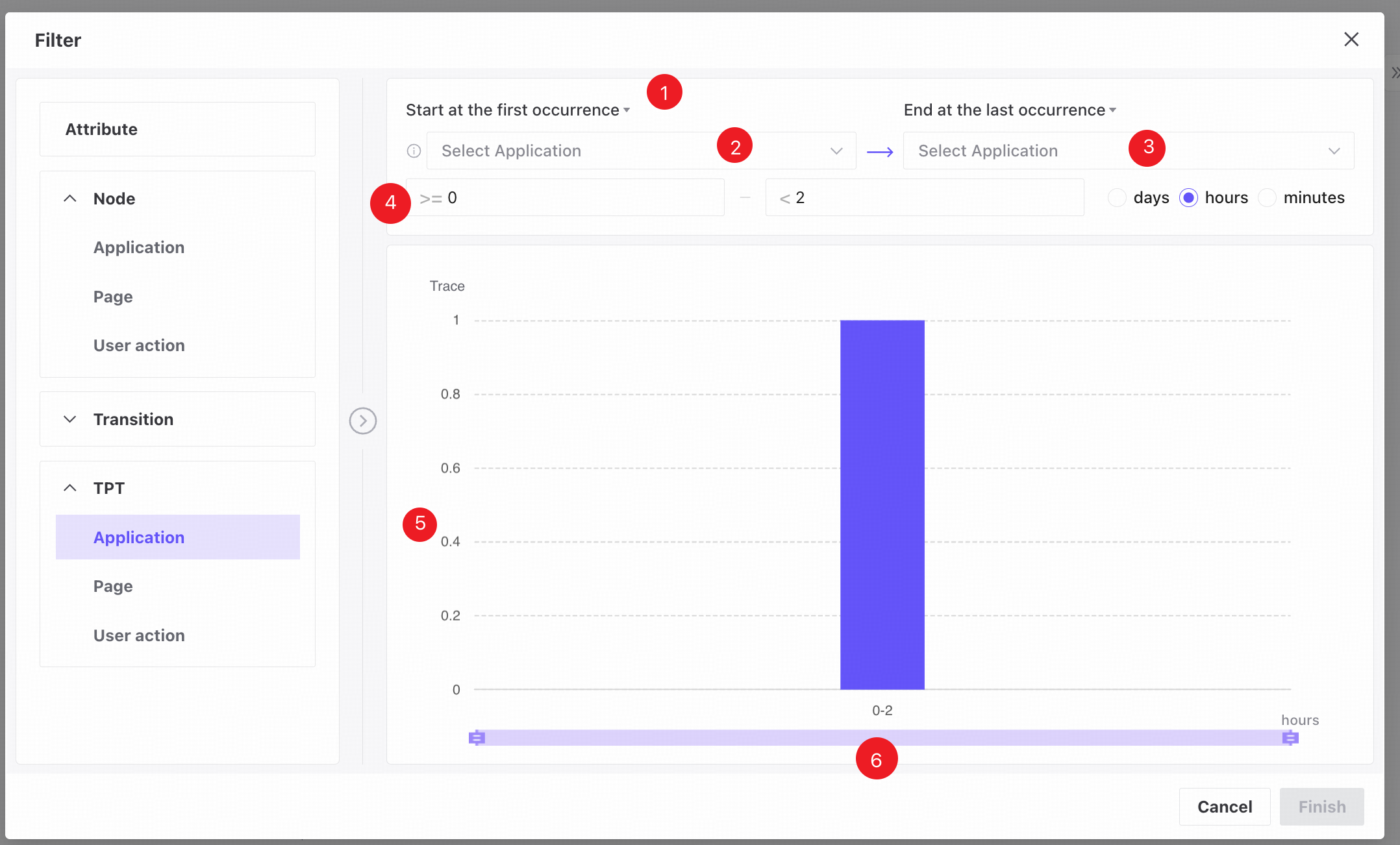
❶ Choose the first or last node occurrence.
❷ Select the start node.
❸ Select the end node.
❹ Enter a start value, end value, and time unit to filter cases by throughput time. Use the up/down arrows to adjust values in increments of 0.1. Defaults are the minimum and maximum values in the data. Available units are days, hours, and minutes; days is selected by default.
❺ The histogram shows time ranges on the X-axis and case counts on the Y-axis.
❻ Drag the time range slider to adjust the range and view the corresponding data.
Bookmarks
Bookmarks work in the same way as in Process mining. For details, see Bookmarks. Bookmarks are separate for Page view, App view, and individual task analysis pages.